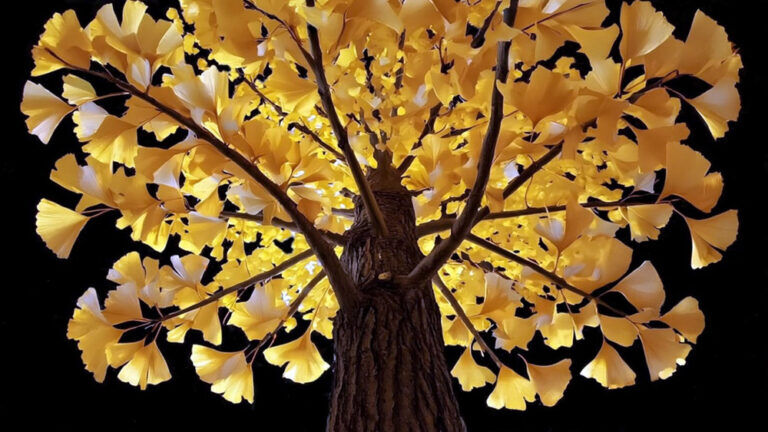
From January 15 to April 15, 2026, the large LED wall on the ground floor of Palazzo Citterio hosts ''Vanishing Trees,'' a site-specific installation by Debora Hirsch, curated by Clelia Patella. The project intertwines digital art, science, and memory, placing the theme of biodiversity at risk at its center.
Promoted by Palazzo Citterio and the MNAD - Museo Nazionale dell'Arte Digitale, in collaboration with the Brera Botanical Garden and with the scientific support of the New York Botanical Garden, the work draws on the historical collections of the Brera Botanical Garden. These include specimens of Ginkgo biloba, Pterocarya fraxinifolia, and Torreya taxifolia, three species now threatened with extinction and the focus of the installation.
Using generative technologies, Vanishing Trees reworks images of these species-classified on the IUCN Red List as threatened, vulnerable, and critically endangered-transforming them into digital presences continually forming and dissolving. A visual cycle that recalls natural processes and reflects on the tension between growth and disappearance, memory and oblivion.
In the video, the trees speak in the first person thanks to the texts of Lucas Mertehikian, director of the Humanities Institute at the New York Botanical Garden. By replacing the human gaze with that of nature, the artist restores centrality to plant elements and invites a profound reflection on the relationship between humanity, time, and the environment.
Promoted by Palazzo Citterio and the MNAD - Museo Nazionale dell'Arte Digitale, in collaboration with the Brera Botanical Garden and with the scientific support of the New York Botanical Garden, the work draws on the historical collections of the Brera Botanical Garden. These include specimens of Ginkgo biloba, Pterocarya fraxinifolia, and Torreya taxifolia, three species now threatened with extinction and the focus of the installation.
Using generative technologies, Vanishing Trees reworks images of these species-classified on the IUCN Red List as threatened, vulnerable, and critically endangered-transforming them into digital presences continually forming and dissolving. A visual cycle that recalls natural processes and reflects on the tension between growth and disappearance, memory and oblivion.
In the video, the trees speak in the first person thanks to the texts of Lucas Mertehikian, director of the Humanities Institute at the New York Botanical Garden. By replacing the human gaze with that of nature, the artist restores centrality to plant elements and invites a profound reflection on the relationship between humanity, time, and the environment.