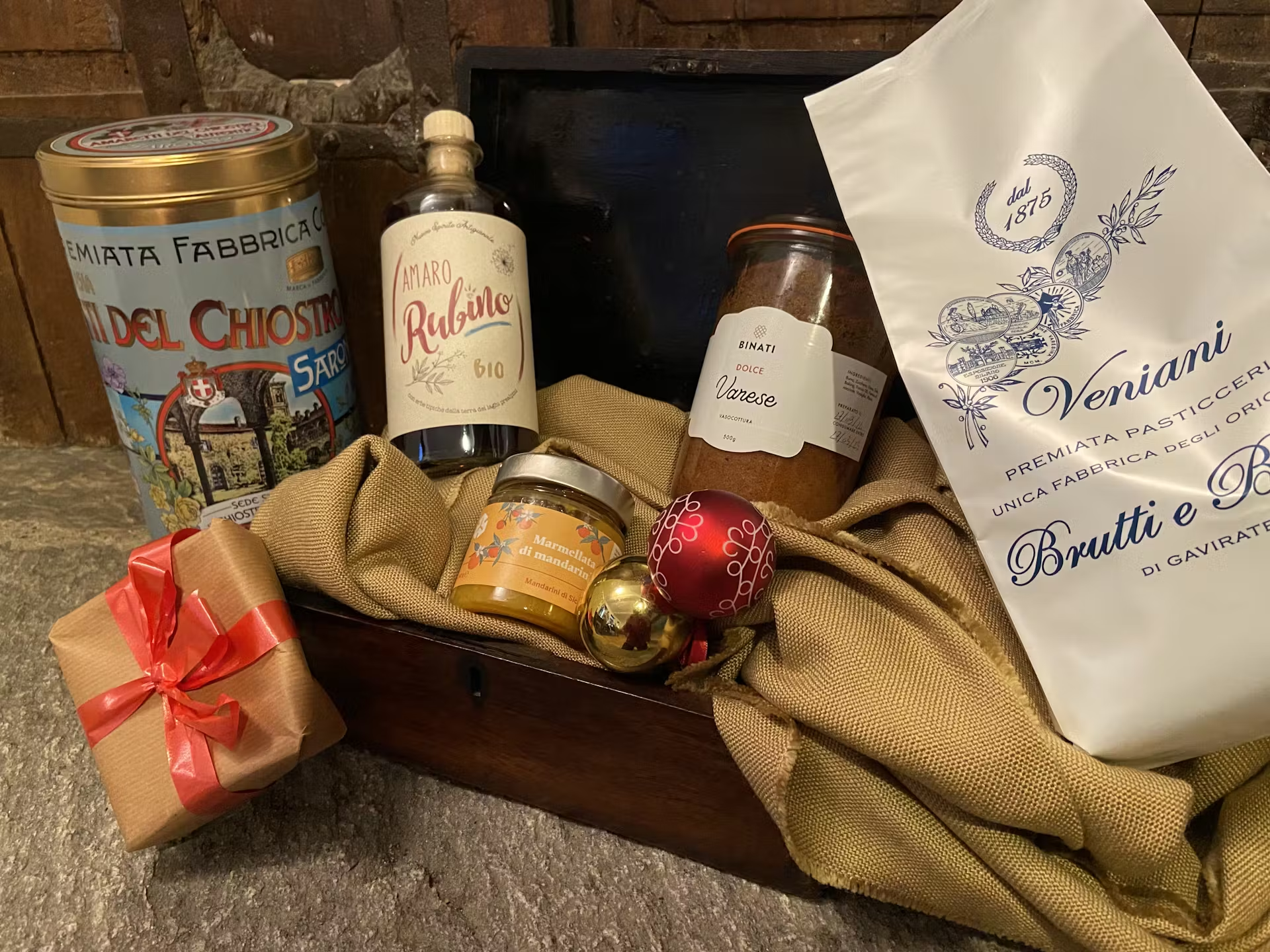
At Villa della Porta Bozzolo in Casalzuigno (VA), the wait for Christmas is marked by special guided tours that conclude with a tasting of traditional Lombard products, revealing their charm and curiosities.
The ''Tours with Tasting'' events are on November 30th, December 6th, 7th, 8th, 13th, and 14th.
Nestled in the Valcuvia landscape, near Lake Maggiore, Villa Della Porta Bozzolo-FAI Property has developed over the centuries from a 16th-century core. In the second half of the 17th century, the Della Porta family transformed the house into a farmhouse, expanding it around a courtyard overlooking a garden. In the 18th century, the villa became a refined stately home, embellished with frescoes and a large scenic park. Having changed hands over time, in 1877 it was acquired by Senator Camillo Bozzolo, who oversaw its preservation.
The park, created in the early 18th century and likely designed by the ''painter and engineer'' Antonio Maria Porani, features an original structure: extended lengthwise due to the lack of frontal space, it is divided into four terraces connected by a monumental staircase with statues and fountains in Viggiù stone. Adding to this scenic layout is the ''theater,'' a gently sloping lawn that leads, via a wooded path, to the Belvedere hill, the most evocative point of the property.
The ''Tours with Tasting'' events are on November 30th, December 6th, 7th, 8th, 13th, and 14th.
Nestled in the Valcuvia landscape, near Lake Maggiore, Villa Della Porta Bozzolo-FAI Property has developed over the centuries from a 16th-century core. In the second half of the 17th century, the Della Porta family transformed the house into a farmhouse, expanding it around a courtyard overlooking a garden. In the 18th century, the villa became a refined stately home, embellished with frescoes and a large scenic park. Having changed hands over time, in 1877 it was acquired by Senator Camillo Bozzolo, who oversaw its preservation.
The park, created in the early 18th century and likely designed by the ''painter and engineer'' Antonio Maria Porani, features an original structure: extended lengthwise due to the lack of frontal space, it is divided into four terraces connected by a monumental staircase with statues and fountains in Viggiù stone. Adding to this scenic layout is the ''theater,'' a gently sloping lawn that leads, via a wooded path, to the Belvedere hill, the most evocative point of the property.